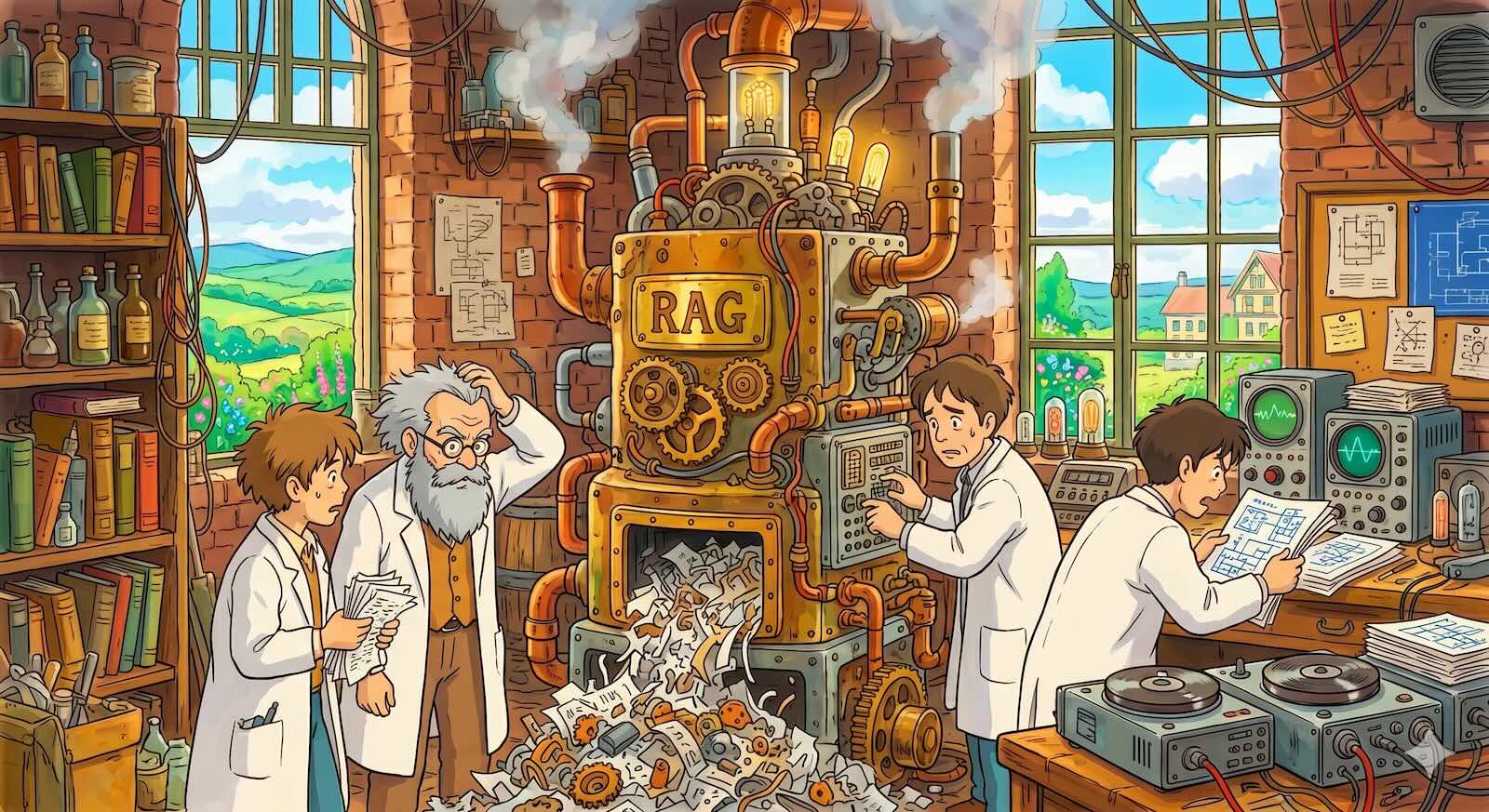
C'mon RAG, WTH?!? Ghibli-core AI Art circa 2025. Gemini 3.0.
No RAG. No infrastructure.
Retrieval-Augmented Generation (RAG) was an overly complicated, infrastructure heavy workaround. Not a solution. RAG is essentially a shredder. Chunking destroys document structure — a cell separated from its table header has no meaning, a sentence pulled from its section has no context, a value with no source address cannot be verified. Vector similarity retrieves what is probably relevant, not what is definitively correct. The chunk you needed might not rank highest. The value you need might be split across two chunks. There is no trace back to the source. No verification that what was retrieved was even the right thing.
Tasset eliminates the retrieval problem entirely simply by not creating a retrieval problem. ADAP knowledge coordinates are computed at the source of creation and stored in the file. The coordinate index is the map. AI navigates by anchored data addresses, not by similarity. No vector database. No embedding pipeline. No retrieval infrastructure to build, host, or maintain. The ADAP format is self-contained within each data file.
For enterprises, this matters operationally. A RAG system requires infrastructure: embedding models, vector stores, chunking pipelines, retrieval tuning, ongoing maintenance. A Tasset corpus requires a pipeline run. The file carries everything the AI needs. Accuracy does not depend on what a retrieval layer returns — it depends on what the ADAP coordinate resolves to.