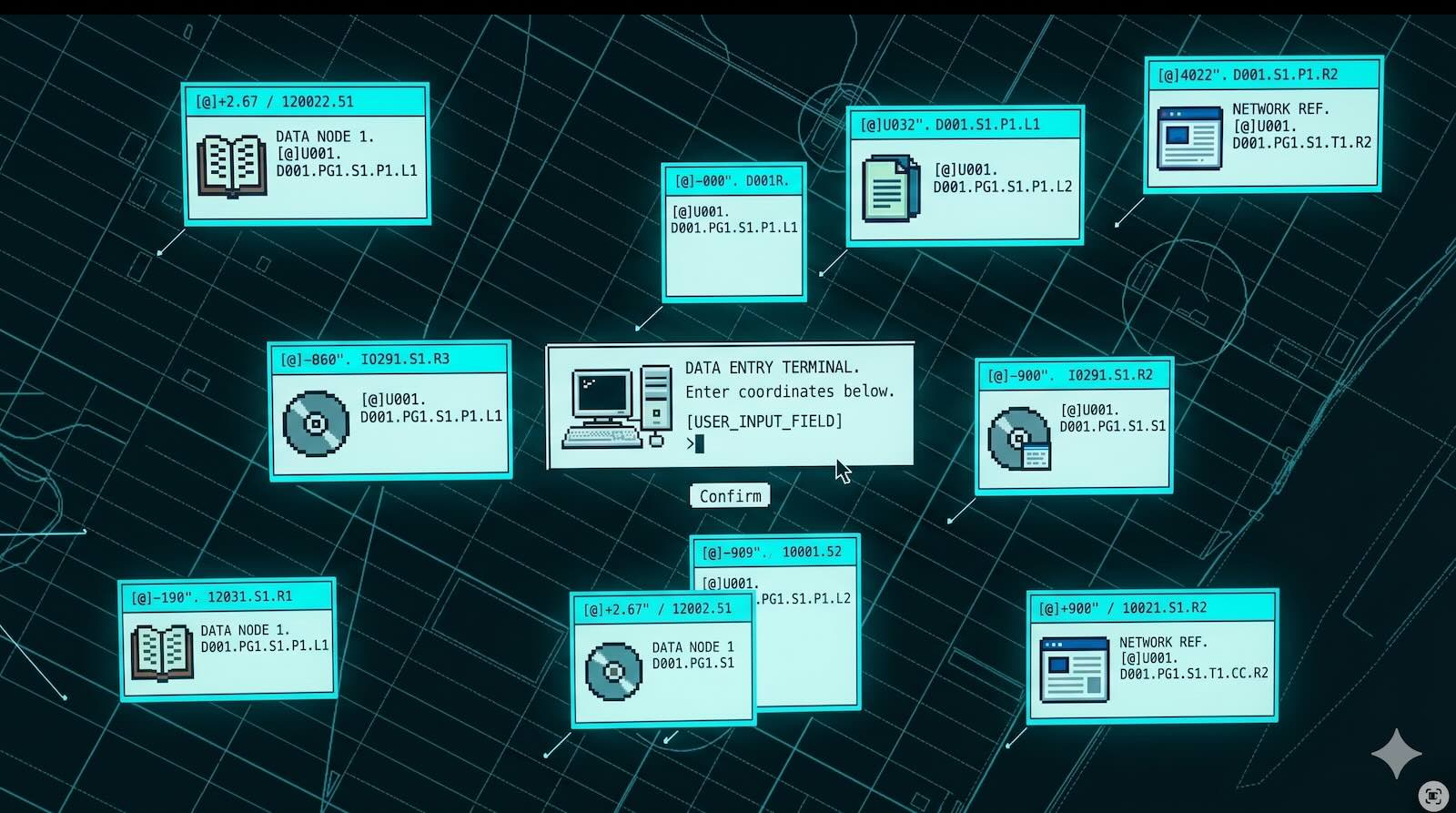
Data Coordinates. 16-Bit Cyberspace GUI AI art circa 1990's. Gemini 3.0.
ADAP
The internet addressing stack has had two layers. Domain names (1990s) made servers findable. URLs (2000s) made pages findable. Neither addressed the information and data inside the page. ADAP stands for Agentic Data Address Protocol. Tasset’s proprietary, patent pending addressing layer for atomic knowledge. Where a URL locates a document, an ADAP coordinate locates every line of information and values within every tabled cell of data.
An ADAP coordinate is assigned by positional arithmetic from the document’s own structure.
D101.PG1.S1.T1.CB.R2: $1,000,000
This anchor is an example table cell coordinate on column B, row 2 in table 1, in section 1 on page 1 from the 101st document and the value in this table cell is exactly: “$1,000,000”.
This cell level anchor is addressable. Meaning it can be traced and clicked back to its exact location to verify and resolve accuracy, original context and attribution from its source file: https://www.yourdomain.com/corpus/D101.PG1.S1.T1.CB.R2
D101.PG1.S1.T1.CB.R2 is not a label or a hash. It is a permanent, verifiable address to one specific cell in one specific document:
f(C) = V
Coordinate (C) maps exactly to the value (V). Permanently, mathematically absolute. Thus, AI navigates by address. Citations resolve by coordinate. The primary AI structural failure modes (attribution, navigation, extraction) are eliminated architecturally by ADAP.
MCP solved tool-calling. A2A solved agent-to-agent messaging. ADAP is the addressable knowledge layer — the missing data protocol in the agentic stack.